You don’t need an abundance of flowers to improve your flower arranging skills. Practicing with just a few stems can actually teach you more about detail and control than a big bouquet. With fewer elements, you can see every placement decision you make: the angle of a stem, the height of a bloom, the distance between each piece. The vase doesn’t fill up as fast, so the arrangement builds more slowly. This slower process allows for more intentional placement and helps your eye learn what looks and feels good and what doesn’t.
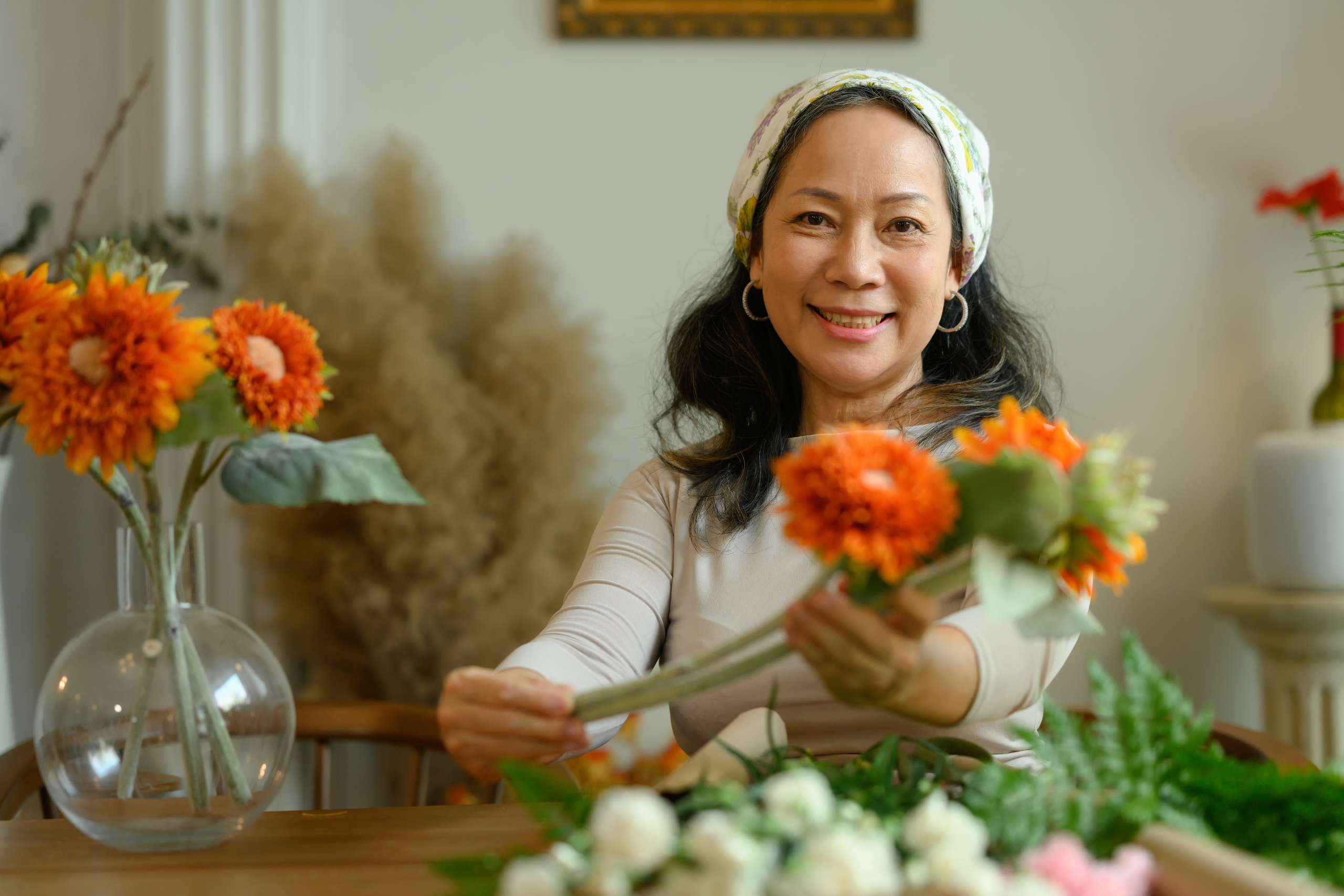
Practice with just three stems of different characters. Perhaps one is upright and wispy, another is full and rounded, and the third is more delicate with some foliage. Place the most upright stem first to establish the general direction of your arrangement. Don’t immediately place the second stem. Hold it over the vase for a second and gently rotate it around before you place it in the vase. You will see how the silhouette changes as you turn it. This simple trick will train your eye to consider various placement options before you commit to one.
One of the biggest mistakes students make when practicing flower arranging is that they assume every flower needs to be placed straight up. In nature, stems grow at an angle, they bend and twist toward the light. Placing them straight up in an arrangement can make the arrangement look rigid and tense. Rather than fighting a flower’s natural movement, try to work with it. If a bloom naturally wants to pitch to one side, let that inform the arrangement’s structure. If your arrangement is looking awkward, try removing a stem and replacing it on a softer angle. Sometimes that simple adjustment can change the entire arrangement.
Try practicing in short increments. Set a timer for 15 minutes and practice arranging with the same three stems. Place the tallest stem in the vase first, then add the remaining stems, then remove all of the stems and start over. With each new attempt, pay attention to the subtle shifts in the heights and the negative space. After a few rounds, you will start to feel more comfortable with the motion of placing the stems and your arrangement will come together more quickly. If you find that your arrangement is starting to look too full, try removing one stem and observing the way the remaining two stems interact. Sometimes less is more.
Finally, practicing with fewer stems will foster creativity. If you don’t have many stems to work with, you will be forced to experiment with different placements, heights, and silhouettes rather than simply adding more flowers to the arrangement. The same three stems can result in vastly different arrangements just by shifting the placement and the negative space around them. This kind of practice will help you develop your sense of form and proportion, which are the building blocks of floral design. Eventually, your eye will learn to recognize balance before you even place the final stem.